
Removing programmes from the Autostart (Windows 7)
Removing programmes from the Autostart (Windows 7)
Finding the Autostart in Windows 7
There are several ways to affect the autostart. However, in this tutorial we have only chosen one of these options, as it also works under other Windows installations. In addition, no external programmes are necessary.
-
- In a first step,open the Start menu
by clicking on the Windows button in your taskbar.
-
- In the input field Search programmes/files, look for the application Run and open the command line with a mouse click.
Note: Alternatively, you can also use the key combination Windows key + R
- In the input field Search programmes/files, look for the application Run and open the command line with a mouse click.
to call up the command line under Windows 7.
-
- Type the command msconfig
into the input field via the keyboard. This opens the system configuration of your operating system. Here you will find the autostart services.
- In the tab menu, switch to the item System start
. Voilà: The services now displayed are loaded in the background at every start.

Remove programmes from the Autostart
Now we can start to clean out the Autostart a bit and deactivate all services, applications and programmes that are not needed at all during system start-up. Most of the time, there are many, many of them.
Note: Make sure, however, that you only deactivate services in the Autostart that you really do not need.
However, all changes can be easily undone if necessary. In this case, however, remember what you have deactivated.
-
- To prevent a programme from being included again the next time you start the system, you can easily deactivate it via the small box in the System Start-up Element
area. Simply remove the tick in front of the respective programme.
- When you have deselected all applications whose start should be prevented, you must confirm your intervention by clicking on Apply. You can then close the System Configuration window by clicking on OK.
- Windows 7 will now inform you that all changes will only be carried out after a restart
. Carry this out and enjoy the faster system start.

Putting applications in the autostart
Now, however, it may happen that we want to put an application itself into the autostart under Windows 7, which cannot be selected or deselected simply by ticking it. In other words, a programme that does not appear at all in the previous list.
-
- To add such a programme to the Autostart, click once on the Start button in the taskbar and select the entry All Programs
.
-
- There, among the numerous files and folders, you will also find one called Autostart
. By default, this is empty under Windows 7.
-
- Right-click on this folder and select the Open
button in the context menu that opens. A new window opens.
- You can now copy application shortcuts
into this window, which will then be executed in the background during a repeated system start. If you remove these shortcuts again, they also disappear from the autostart.

Note: Be careful to only put shortcuts in the named folder
and not the .exe of a programme, otherwise it „can’t find“ its own path. We have summarised how to create such a shortcut for you in the article Windows 7: Creating a Shortcut.
Which programmes should be deactivated in the Autostart?
Unfortunately, it is not possible to give a blanket answer to this. However, most applications that are automatically started at system start-up are not necessary.
In any case, we would recommend that you leave your computer’s antivirus programme in the autostart and also not prevent all applications that are related to the sound or graphics card from starting. However, this is not generally valid.

Windows Server 2019: Important innovations at a glance
Windows Server 2019: An overview of important new features
Better container support, optimised interaction with Azure and easier encryption. Here's a look at the best new features in the upcoming Windows Server 2019.
Windows Server 2019 comes with a wealth of new features. Collaboration with Microsoft Azure is improved, container technology is significantly expanded and Linux finds broad support. File servers with Windows Server 2019 can also be operated much more effectively and migrations can be carried out more easily. We give a preview of the ten best new features.
All the new features from Windows Server 1709/1803
Windows Server 2019 will include all the new features from the semi-annual versions Windows Server 1709 and Windows Server 1803. These include optimised container management, better Storage Spaces Direct, expanded support for Linux and more. There’s also the added benefit of Windows Server 2019 getting a graphical interface to make the new features easier to manage.
New container image with almost complete Windows server
With Windows Server 2019, Microsoft provides a new container image with the current name „windows“. In addition to the two images „nanoserver“ and „windowsservercore“, the „windows“ image is supposed to have a greatly expanded range of functions with which almost all Windows programmes can be used. This means that developers can also run apps in containers with which this is currently not possible.
Kubernetes support and better containers
In general, Microsoft wants to improve the work with containers with Windows Server 2019. Windows Server 2019 will work directly with Kubernetes so that hybrid container environments can also be operated. The individual images for containers will be improved. For example, the core image will be further reduced in size, the nano image will be expanded, and collaboration between containers will be optimised.
Better virtualisation of Linux servers
Linux servers can be virtualised better with Windows Server 2019. In addition, Linux servers can be secured with shielded VMs in Windows Server 2019. This is currently only possible with Windows servers. In general, Linux will connect better with Windows Server 2019.
Windows Subsystem for Linux
The Windows Subsystem for Linux enables the integration of a Linux distribution within a Windows installation. This allows Linux servers to be managed directly from Windows servers using Linux commands. Windows servers can thus also be administered via Linux commands. This improves cooperation between Linux and Windows enormously. Numerous distributions are to be added in Windows Server 2019.
Windows Defender Advanced Threat Protection (ATP)
Windows Server 2019 works directly with Windows Defender Advanced Threat Protection. This is an advanced attack protection that works without signature files and can detect zero-day attacks and root kits. The service has cloud connectivity and reliably detects attacks that are not detected by virus scanners. ATP does not replace anti-malware scanners, but complements them.
Better encryption
In Windows Server 2019, data can be encrypted easier and better. Network traffic can also be encrypted better in Windows Server 2019. This also applies to virtual machines.
Storage migration wizard from numerous sources
The new Storage Migration Service helps migrate file servers and the data to Windows Server 2019. The wizard can also move data from NAS systems, works with Microsoft Azure, and can transfer data and permissions quickly and easily. The target can be servers running Windows Server 2019, and the source can be a whole range of devices. Migrating to Windows Server 2019 should be easier than ever for this reason.
Better integration with Microsoft Azure
Windows Server 2019 works more closely with Microsoft Azure. Data can be synchronised between Azure and Windows Server 2019, data can be backed up with Azure Backup, and file servers can be populated with data from the cloud via Azure Files. Clusters can be connected to Microsoft Azure, and the aforementioned Storage Migration Wizard can also import data from the cloud or back up data to the cloud.
New express updates
Windows 10 computers and current Windows servers, as well as Windows Server 2019, will benefit from the new Express Updates. Express Updates are much smaller than the current Cumulative Updates and Delta Updates, which only reload missing updates. Express updates work much like backups that build on each other and can be downloaded and installed much faster. It also significantly reduces the number of reboots.
Header image: © AliFuat, stock.adobe.com

Installation of ISO files & activations of (Office 2013, 2016 & individual applications Word, Excel, Powerpoint etc.)

- Click on„Install now“ to install all office applications or customise the installation by clicking on„Customise„.


- Installation has been completed successfully, click on „Close“
Activating Office
- Start any Office application (e.g. Word) and open an empty document.
- Now click on „File“ in the top left-hand corner and then on „Account“.
- Now you will find the option on the right under „Product Information“ to enter the key you received from us there under „Change Product Key“.
- Then enter the product key and click on “ Install“ to complete the activation.


Header-Bild: © monticellllo, stock.adobe.com

Manually make USB stick bootable/ prepare UEFI USB stick
Diskpart - Manually make USB stick bootable/ Prepare UEFI USB stick
Prepare UEFI USB stick
Create a new primary partition on the USB stick using Diskpart, format it with the FAT32 file system and assign a drive letter. To do this, execute the following commands:
diskpart
list disk
select disk #
clean
create partition primary
select partition 1
active
format quick fs=fat32
assign
exit

Copy Windows installation files to the USB stick
Next, the Windows installation files must be copied to the USB stick. You can do this simply by using Copy – Paste. It does not matter whether you have mounted an ISO image in Windows, unpacked it or inserted an installation DVD. If the install.wim file of the Windows image is larger than 4GB, an error will occur during the copying process. At the end of the copying process, a message will appear stating that the file is too large. This message appears because the FAT32 file system has reached its limits and cannot process >4GB files. To still be able to complete the UEFI USB stick, you have to use a little trick: Using DISM, the file must be split into two or more <4GB files. Please note that this procedure is only supported by Microsoft up to Windows 7 or Windows Server 2008.[3] [4] To do this, simply enter the following command:
-
Dism /Split-Image /ImageFile:E:sourcesinstall.wim /SWMFile:C:UsersAdministratorDesktopinstall.swm /FileSize:3000
- /ImageFile: Path of the source file install.wim in the sources folder of the Windows ISO
- /SWMFile: Path of the splitted target files
- /FileSize: maximum size of the splitted target files in MB

Now the splitted install.wim, install2.wim, install3.wim etc… can be copied to the USB stick in the „sources“ directory.
Fix error message status 0xc0000d
If you get the error message EFIMicrosoftBOOT\BCD status 0xc000000d when booting the USB stick, please check the following things:
- If it is a system with Secure Boot, disable Secure Boot.
- Select the USB stick (not Windows Boot Manager) in the boot menu.
Booting should work afterwards.
Header image: © PheelingsMedia, stock.adobe.com

You want to install Windows 10 on your PC? using Windows MediaCreationTool
You want to install Windows 10 on your PC? using Windows MediaCreationTool
Create bootable USB stick for Windows 10 from the Internet
If Windows 10 is available to you as an ISO file, the easiest way to create a bootable USB stick is based on Windows 7 or Windows 8 / 8.1 as well as Windows 10. Microsoft provides the ISO files of Windows 10 free of charge. You download the free MediaCreationTool from this page and run it. Then download the ISO files. To do this, select the option Create installation media for another PC.

If you have an ISO file of Windows 10, you can download an ISO for free from Microsoft using a tool.
02. Selecting the edition, language and architecture
On the next page of the tool , you then select the language you want, the edition you want to download and the architecture, i.e. 32-bit or 64-bit. The Enterprise Edition is not available via this route. If you want to create a bootable USB stick from it, you have to get the ISO file in another way.

In the MediaCreationTool you can download an ISO file with your desired edition if you wish.
03. Perform ISO download and select USB stick
In the next step, you can either copy the installation files immediately to a suitable USB stick or download the installation files as an ISO. This is the best way in most cases, as you can quickly and easily create a USB stick from the ISO at any time.

You can quickly and easily create an ISO file from the MediaCreationTool, or a bootable USB stick.
04. Finalise configuration
If you want to create a USB stick from the MediaCreationTool, it must now be connected to the computer. Then you can select which stick you want to use. The stick must have at least 4 GBytes of memory, preferably more. The wizard then downloads the Windows 10 installation files and copies them to the USB stick or to the ISO file.

In the Windows 10 Download Wizard, you can select a USB stick.
05. Creating a bootable USB stick from an existing ISO file
If you already have an ISO file of Windows 10, you can also create a bootable USB stick from Windows 7/8/8.1/10 using on-board tools. To do this, make the ISO file available as a drive via the context menu and start a command prompt with administrator rights. The USB stick must also be connected to the computer. Start a command prompt for this via the context menu in administrator mode. For example, enter cmd on the start page/start menu, click on the command prompt symbol that appears and click on Run as admin.

In Windows 8/8.1 and Windows 10, start the command prompt with administrative rights to create a bootable USB stick.
Header image: © rvlsoft, stock.adobe.com
Create screenshot (Windows 10)
Create screenshot (Windows 10)
This does not even require any other programmes to be downloaded and installed anywhere. Windows itself has programmes such as the „Snipping Tool“. Alternatively, screenshots can also still be provided with symbols and other coloured markings using tools such as „Paint“.
How to take a normal screenshot under Windows 10
If you want to take a screenshot of the current screen content, press the key combination “ Windows key + Print“. The image is now saved in the clipboard and can be pasted from there into a programme such as „Paint“. To do this, press the key combination „Ctrl + V“. If you use several monitors, a complete large image of all screens is created. Alternatively, to take a screenshot of the current active window, press the key combination „Alt+Print“. Again, the screenshot can be pasted into any programme with „Ctrl + V“
How to create a screenshot with the Snipping Tool
The Snipping Tool is an on-board Windows tool. If you want to take a screenshot quickly, it is best to call up the small programme in the Start menu by entering its name. After the tool has started, you can mark the area to be displayed in the screenshot with the mouse pointer. This is particularly advantageous if you only want to show individual small areas. After taking the screenshot, functions such as a highlighter, pen and eraser are available. Furthermore, the screenshot can also be saved or sent directly by e-mail with just one mouse click. Try it out for yourself.
Header image: © charnsitr, stock.adobe.com
Windows 10 Change language
Change Windows 10 language
With Windows 10, it is possible to use not only the language set by default. In addition, other language packages can also be installed, managed and assigned to different users. For example, the respective languages of their user profile are assigned to different speakers and can be changed. In this guide, we will show you how to successfully adjust the language settings.
Managing languages in Windows 10
You have the option to change the user language and keyboard language of Windows 10 at any time. This is how they manage the different languages:
- Add a new language by opening the system settings. To do this, press the key combination „Windows key + I„. Then click on „Change language and keyboard options„.
- In the administration you will see a list of all languages available on the computer under „Preferredlanguages“. When apps and websites are opened, Windows 10 tries to display them in the selected language. If this is not available, the language below it is used. Using the arrow symbols, it is possible to change the order.
- There are symbols to the right of the language. These show you for which areas of application this language is suitable (for example, speech recognition, keyboard language, etc.).
Installing additional languages in Windows 10
- You can install a new language at any time. To do so, click on the „plus„symbolabove the list.
- Now enter the name of the desired language. All languages available for installation are displayed in the results list. Here, too, the symbols to the right of the name indicate what the language can be used for. Click on the language and then on „Next„.
- Now a selection menu opens in which several features can be selected. If you select „Set as my Windows display language„, the entire operating system is displayed in this language.
Change display language in Windows 10
If the installation of the new language was carried out successfully, it can be directly adjusted under „Region and language“ in the settings. Windows is now displayed in the national language.
Change language for home screen and new accounts
- Open the normal and classic control panel to change the display language of Windows 10.
- Enter the term „Region“ in the search field and then open the search hit.
- Switch to the „Administrative Tools“ tab and click on „Copy Settings“.
- At the bottom, you now have the option to change the activated display language for the start screen, the lock screen and newly created user accounts by means of checkboxes. Click on „OK“ to apply the new settings.
Change keyboard language in Windows 10
- If several languages are installed, you can change the keyboard language in Windows 10 separately.
- To do this, press the key combination „Windows key + space bar„.
- A small info box opens showing the available languages. Now click the „space bar“ again to switch back and forth between the languages.
Change speech output in Windows 10
- The voice output can also be changed in Windows 10. To do this, open the „Speech output settings“ in the system settings. Enter the term in the search field.
- The individual languages are displayed in the list under „Select voice„. These are installed together with the respective language package.
- After selection, you can also change settings such as „Speech speed“, „Voice pitch“ and the „Voice volume„.
Changing the language of Cortana voice input in Windows 10
- To change the language of the Cortana speech input, open the system settingsas in the previous step and search for „Settings for speech recognition“.
- In the upper selection, you can then change the desired speech recognition language for Cortana. Further settings such as speed are also possible here.
Header image: © kotoyamagami, stock.adobe.com
Windows 7, 8 and 10 - What are the differences?
Windows 7, 8 and 10 - What are the differences?
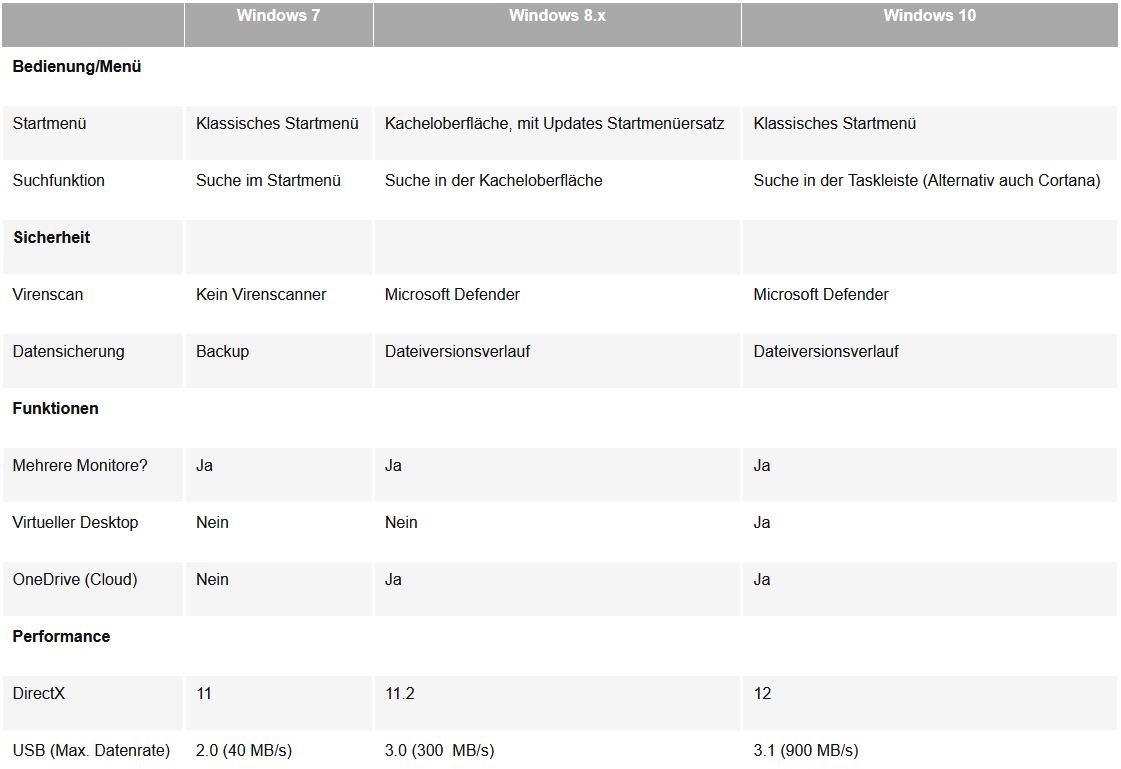
Which version of Windows is right for me? You may have asked yourself this question before and even thought about switching to another higher version. What is there to consider? What are the differences? In this Windows 7, 8 and 10 comparison, we take a close look at all 3 operating systems and explain their features. After that, you should be sure which Windows is right for you. All 3 versions are actively developed by Windows and regularly provided with updates. This primarily ensures more security against attackers and other malicious programmes, but also stability. If you still have an older operating system such as Windows XP, we strongly recommend that you switch to 7, 8 or 10. All versions below this are no longer supported and are therefore no longer provided with security updates. If you compare Windows 7, 8 and 10, the first thing you notice is the graphical user interface, which has changed a lot. From Windows 8 onwards, Microsoft caused a lot of confusion with the tiles instead of the classic desktop and quickly took a different course. With updates and extensions, the classic desktop screen with Start menu was brought back, because that is what users are and were used to. In the background, some technical developments and changes have taken place, which we would like to discuss in more detail in the following sections.
Operation and start menu
Windows 7 has the classic Start menu, as users have always been used to. With version 8 came the big change with the tile interface, which caused a downright dislike among many users. As already mentioned, several updates were rolled out, with which Windows 8.1 got back its classic desktop overview with Start menu. Nevertheless, Microsoft has not abandoned its concept with the tiles, as can be seen very clearly in Windows 10. Still, the good old Start button at the bottom left is back and makes for a much friendlier experience.
Search under Windows
In Windows 7, the search field can still be found in the Start menu, where programmes and files of all kinds can be found. With Windows 8, all you have to do is open the tile interface, now you can simply enter a term without having to click on a search field. Search results from the Bing search engine are also displayed. In Windows 10, on the other hand, the search field can be found in the taskbar and can alternatively be displayed as a small icon. Microsoft has also released the search assistant Cortana with Windows 10, which responds directly to voice commands and answers them.
The functionality of Windows
Those who want to use multiple monitors do not have to do without this in all 3 versions. With Windows 10, even virtual desktops can be managed for the first time, which is not the case with 7 and 8. You want to access files from your laptop, tablet or smartphone at the same time and share them with others? Then OneDrive is the right thing to do! However, this handy tool is only available for Windows 8 and 10, not for 7. Windows 7 still works with Internet Explorer 8, while Windows 8 and 10 work with Internet Explorer 11 or 11 Edge.
Safety First! This is how safe the Windows versions are
While you have to install an extra virus scanner with Windows 7, 8 and 10 come with the in-house virus scanner Defender. This is a security software from Microsoft that scans your files for viruses, malware and spyware. With Windows 8 and 10, the new Secure Boot system was released, which provides more security when starting the computer. Windows 7 does not yet have this tool on board. To make a backup of the files, Windows 7 still has the classic backup. Windows 8 and 10 have a file version history, which automatically backs up data in the background.
Performance
While DirectX 11 is still installed on Windows 7, Windows 8 and 10 come with DirectX 11.2 and 12. There are also some differences in the supported USB versions. Windows 7 still works with 2.0, Windows 8 and 10 support USB 3.0 and 3.1. This allows higher data rates, so files are copied back and forth to your USB medium or device faster.
Comparison table
In the following we show you once again the most important facts and differences between Windows 7, 8 and 10 in a clear table.
Header image: © monticellllo, stock.adobe.com

Remove / disable start-up programs in Windows 10
Remove / disable startup programs in Windows 10
When the computer is switched on, some programmes start automatically when the computer boots up. The so-called start-up programmes (also known as Autostart) can thus be used more quickly. However, not all programmes are always necessary. If a lot of programmes start at the same time, Windows takes a little longer. We show you how to remove or deactivate certain start-up programmes in Windows 10 that are not needed. Often, programmes are simply added to the startup list after installation, even though you don’t want them to be or don’t know about them. Find all programmes that load unnecessarily and thus take up system performance unnecessarily.
How to remove and disable unnecessary start-up programmes in Windows 10
- Open the task manager. For example, you can use the key combination„Ctrl+Shift+Esc„
- In the task manager you will see an overview of all currently open programmes
- Click on„More details“ at the bottom left
- In the overview, click on the„Autostart“ tab. All programmes that can be opened automatically at system start-up are displayed here. Behind each programme name you can see the respective„Status„. This is either activated or deactivated.
- Click on„Status“ at the top to group all elements. In this way, you can see in groups which programmes are intended for automatic system start-up.
- To exclude an activated programme from the autostart, click on it with the right mouse button. Then click on„Deactivate„. It will no longer be loaded at the next system start.
Header image: © dennizn, stock.adobe.com
Merge partitions in Windows 10
Merge partitions in Windows 10
Managing and setting up partitions can be quite useful. They provide more order and overview on the hard disk. If certain storage spaces are no longer used and are superfluous, these partitions can be assigned to others. In this article we explain how it works.
How to merge partitions in Windows 10
Windows 10 has its own tool for this purpose, which can be used to manage partitions. The disk management. In any case, it is important that all files on the partition are backed up beforehand. Partitions that are used by Windows and contain backup/restore points cannot be easily dissolved.
-
- Click with the right mouse button on the Windows symbol (bottom left in the task bar) and then on „Disk Management
„.
-
- Now select the partition in the administration that is to be dissolved and assigned to another partition. To do this, click on the partition with the right mouse button and on „Delete volume
„.
-
- Now the deleted partition is available as „Unallocated
volume“.
-
- Select the partition that is to be enlarged. Click with the right mouse button on the drive and then on „Expand Volume
„.
- Now select the volume you deleted in step 2.
- Both partitions are now merged and your new larger drive is ready for use.
Header image: © Pichsakul, stock.adobe.com